Designing for Reality: Why Continuous BOM Optimization Matters
How Parter’s continuous BOM optimization helps hardware teams clear supply chain bottlenecks, lower costs, and scale to mass production from day one.
Building hardware has always been tough, but the rules of the game have fundamentally changed. Today's electronics market moves at a breakneck pace. Lifecycles are shrinking, lead times are compounding, and that "datasheet-perfect" component you carefully picked during initial prototyping might be completely gone by the time you are ready to tape out.
Until now, the industry standard for dealing with supply chain chaos has been reactive: wait for an End-of-Life (EOL) alert or a lead-time spike, scramble to find a single drop-in replacement, drop it in, and move on.
The problem with fixing parts one at a time? Every signal you are not chasing is one you are not checking. You might close one operational gap only to open three new ones: accidentally picking a component that costs twice as much, relies on a single source, or ships in 40 weeks.
That is why we are launching the next evolution of Parter, alongside our rebranded home at parter.ai.
The Shift: Embedding Optimization into the Early Build Phase
This launch marks a massive product leap forward in our core mission: embedding supply chain optimization directly into your early build phase.
Rather than treating supply chain bottlenecks as an after-the-fact emergency for procurement to clean up, Parter asks a simple question from day one:
"What if every build was optimized from the start, ensuring a seamless scale to mass production?"
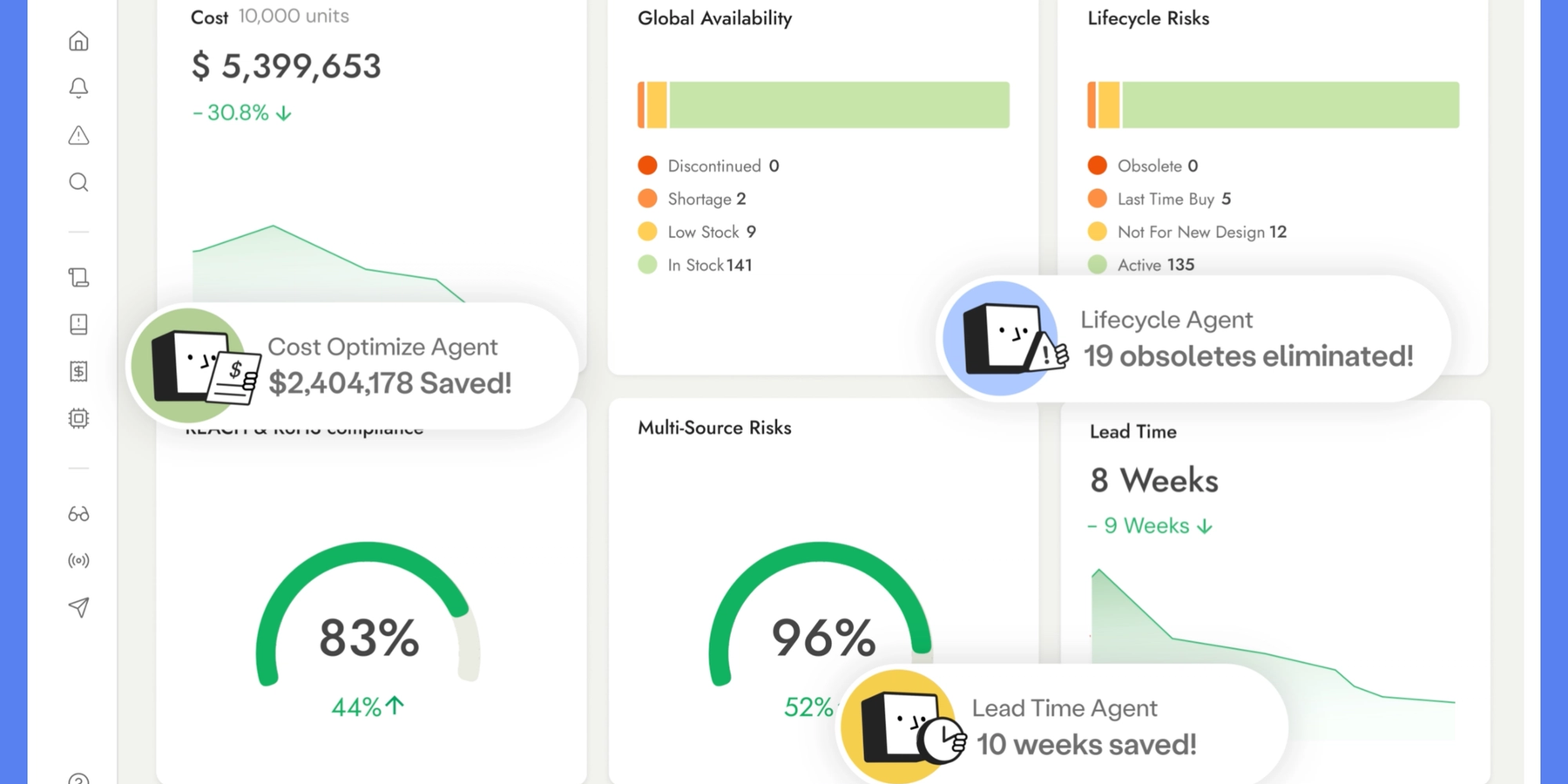
Instead of putting out fires one component at a time, Parter optimizes your entire Bill of Materials (BOM) simultaneously. From day one, our platform weighs lifecycle status, component shortages, unit cost, lead time, and second sources altogether. This gives R&D, NPI, supply chain, and procurement a single, live source of truth.
Why Total Optimization Matters Right Now
The current market reality is ruthless, particularly in volatile sectors like memory. While headlines point to broad 75% price spikes driven by AI demand, the ground truth for hardware teams is often far more extreme:
- Price Volatility: Price is often the slowest signal. On customer BOMs, we have tracked individual components surging over 1,900%.
- Vanishing Stock: Nearly half of the memory parts currently tracked across the market cannot be bought anywhere through traditional channels.
- Compounding Wait Times: For components quoted a year out, average wait times have jumped 325%, even as available global stock dropped by 86%.
A Real-World Case in Point
Just last month, a new customer came to us struggling with a Micron DDR2 part whose price had skyrocketed 560% in ten months.
Using traditional manual methods, finding, vetting, and engineering around a replacement would have taken up to three months of redesign work. Parter's AI agent scanned the datasheet and identified ten candidate options in minutes:
- 2 were true drop-in replacements (both with zero global stock).
- 8 required engineering review, including one candidate that was scheduled to go EOL just four weeks out.
By evaluating the full picture instantly, the team avoided walking directly into another dead-end supply bottleneck.
What Total BOM Optimization Delivers
Moving from reactive part-swapping to full-build optimization completely eliminates the redesign scramble. By aligning the entire BOM around design intent and market reality from day one, hardware teams achieve remarkable results:
Metric
Impact with Parter Total Optimization
BOM Unit Cost - 26% reduction
Single-Source Risk - 92% fewer single-source parts
Stock Risk - 87% overall risk reduction
Lead Times - 37% faster delivery
The end result? The exact same design intent, delivered to market faster, with fewer costly board spins, and a hardware team that spends its time building and shipping rather than patching supply chain failures.
Design for Reality with Parter
Hardware is hard enough without constantly chasing market volatility. When you design for reality, the market stops being something that breaks your project. Instead, it becomes an environment you build around seamlessly.
The busywork is ours. The building is yours.